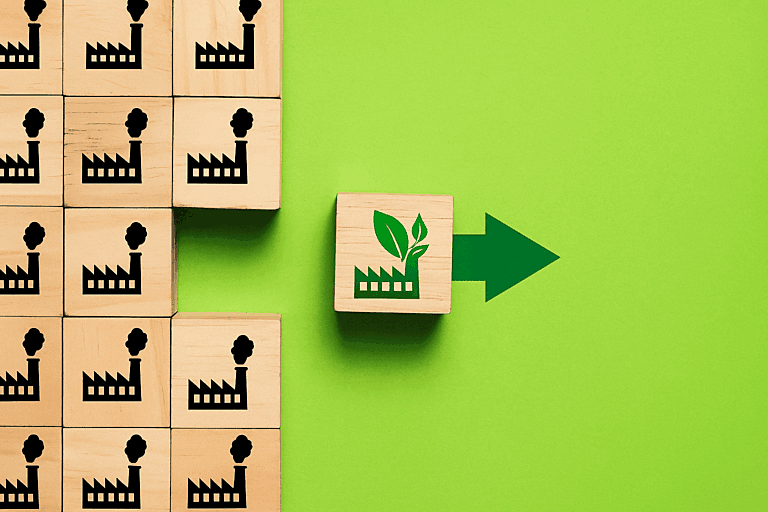
More and more companies are publicly committing to sustainability, carbon neutrality, or ESG goals. But what is actually behind these statements? While genuine transformation is taking place on the one hand, others are engaging in deliberate greenwashing—that is, consciously pretending to be environmentally responsible in order to polish their image.
It is becoming increasingly difficult for consumers, investors, and business partners to distinguish between appearance and substance. This article shows how greenwashing works, how to recognize credible commitment, and why transparency, impact, and partnership are the new currency of genuine sustainability.
What is greenwashing – and why is it problematic?
Greenwashing describes the attempt to make a company, product, or service appear more sustainable than it actually is. This often involves less direct misrepresentation and more strategic vagueness, selective communication, and a lack of impact.
The United Nations warns:
“Greenwashing undermines credible climate action.”
Greenwashing is no longer just a PR problem—it is a massive reputational and investment risk:
- According to the University of Chicago (2025), over 60% of investors are concerned about greenwashing and poor data quality in ESG investments.
- In 2024, the term “cross-washing” was introduced on the research platform arXiv: sustainable peripheral activities are highlighted, while the core business remains unchanged.
- New regulations such as CSRD, SFDR, and the ISSB standard place greater emphasis on transparent and comparable sustainability information – with the aim of making greenwashing more difficult.
How to recognize genuine sustainability
1. Concrete action instead of empty promises
Credible companies don't just communicate their intentions, they also report measurable progress. Instead of saying, “We are committed to protecting the climate,” they should say:
“Reduction of Scope 1 emissions by 35% by 2026 compared to 2019 – validated by GHG Protocol.”
2. External audits and standards
Those who take sustainability seriously disclose verified evidence – for example, through B Corp, the UN Global Compact, GRI, Science Based Targets, or the International Impact Board (IIB).
“For a standard to be effective, it must be relevant, transparent, reliable, and comparable.”
– Emmanuel Faber, Chair ISSB
3. Holistic implementation
A sustainable product range alone is not enough. Companies that act credibly integrate sustainability into all areas – from the supply chain and energy supply to corporate culture.
4. No symbolic individual projects
A “green” label on a disposable product does not make a company sustainable. What matters is the impact of the business model – not the packaging of the exception.
“The financial world is greenwashing the public with deadly distraction.”
– Tariq Fancy, former Chief Sustainable Investing at BlackRock
5. Partnerships matter – especially in terms of SDG 17
Sustainable transformation rarely succeeds on its own. True sustainability is evident in cooperation: with science, NGOs, communities, or other companies. This is precisely where SDG 17 (“Partnerships for the Goals”) comes in as a litmus test for substance.
What companies should do now
Avoiding greenwashing is not a “nice to have” – it is a basic prerequisite for trust and market access. Companies should understand sustainability as a process: from strategy to impact measurement to communication.
In concrete terms, this means:
- Formulating sustainability goals – measurable, comprehensible, time-defined.
- Systematically recording impact – with tools such as IRIS+ or DN-based frameworks.
- Obtain relevant certifications – through external testing agencies such as the IIB.
- Communicate openly and factually – without exaggeration or vagueness.
Above all, however, it takes the courage to be honest: sustainability can also be a path of development, as long as it is credibly documented.
What Deutsche Nachhaltigkeit contributes
As a listed impact investor, we channel capital specifically into companies with environmental and social impact – for example, in the areas of climate, resource conservation, or social participation. As an anchor investor, it contributes capital, strategic support, and market access to the development of sustainable business models.
Central to this is a standardized impact investment process developed in collaboration with our partner network THE SEVENTEEN. This process helps to systematically measure impact, report transparently, and create investments that enable real change.
Instead of greenwashing, DN focuses on impact, transparency, and capital marketability—for a new quality of sustainable investments.
Conclusion: Sustainability with substance instead of symbolism
Greenwashing is not only unethical—it is becoming increasingly visible, legally risky, and economically expensive. More than ever, companies must be able to prove that they not only sound sustainable, but actually act sustainably.
Those who can measure impact, report credibly, and are willing to invest in genuine partnerships will survive in the new market environment – and build trust.
Because sustainable transformation is not an image project. It is a real competitive advantage.